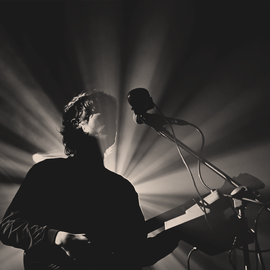
Claude Stucki

Claude Stucki is a guitarist and session musician based in Switzerland. With roots in jazz and a growing obsession with experimental guitar sounds, he has spent recent years pushing the boundaries of what the electric guitar can do - exploring hexaphonic processing, guitar synthesis, and new approaches to sound design.
An active presence inthe Swiss music scene, he plays with artists including James Gruntz, Marc Sway, and Manillio, and is a member of the collaborative band project loophole. He is currently working on a solo instrumental record.
What has previously been your approach to guitar?
I grew up studying jazz and for a long time I was a real tone purist - straight into the amp, clean, minimal gear. My first pedal was a Crybaby, then a Tube Screamer, then a delay pedal, and that was honestly it for years. After finishing my studies I started getting more interested in experimental sounds, production, and sound design, and that gradually pulled me down the rabbit hole of pedals and processing. It's really only been in recent years that I've gone deep into finding genuinely new ways to make the guitar sound different.
How do you use the Submarine?
I came across Submarine Pickup through an Instagram ad years ago. At the time I was playing duo and trio gigs where I was effectively the bass player at the same time, using octave pedals - often an OC-3 - to separate out the bass on the lower strings. When I saw the Submarine pickup that could isolate just one or two strings, I immediately used it to send the lower two strings through an octave pedal for a much cleaner separation. That was my first real experience of splitting the guitar into more than one monophonic signal, and it planted a seed. Later, when I got deeper into hexaphonic processing through Roland GK systems, I started looking for ways to route those six channels into analog effect chains rather than just Roland's own hardware. That's when I discovered the SubSix, and I loved the form factor and the non-committal way you could apply it to a guitar. I've mainly been using it on a baritone guitar, routing it into a Tascam Portastudio as a mixer - four channels with preamps, plus a stereo return that let me plug in all six channels. The Portastudio became the centre piece for experimenting with this setup: adding saturation to each string individually, panning, and exploring what you can do when every string has its own signal path.
What influence has the Submarine had on your creative process or workflow?
Even that first Submarine pickup changed how I conceptualise guitar tone - the idea that a guitar signal doesn't have to be one thing, one chain, was genuinely mind-opening. The SuBSix takes that further. It creates a space for experiments where you don't necessarily know what the outcome will be, and that's exciting. You just set something up and see where it goes.
What have been the surprising discoveries in the time that you've been using it?
Just how much more there is still in the electric guitar. I've always thought of it as a broad instrument in terms of sound possibilities, but working with the SubSix has made it clear that guitar innovation is nowhere near finished. There's so much more to discover. I love vintage guitars, but I'm equally excited by new ideas and seeing where the instrument can be taken next.
Do you plan on using it in any other projects and if so what ideas to you have for its future use?
So far it's been purely a studio tool. I'm still very much in the phase of figuring it out for myself - it's not something I can just hand off to a producer or FOH engineer with six cables and expect to work. But I do have ideas around solo live performance using a hexaphonic setup with six amps or speakers in a room, one per string. Up to now I've only
really experienced the hexaphonic sound on headphones or a stereo system, and I'd love to explore how you translate that spatial quality into a physical room for an audience.
How would you use it in a live setting?
The SubSix I've never used live. But the original Submarine pickup I have used on duo and trio gigs where I'm playing bass on the two lower strings at the same time, kind of a Charlie Hunter approach. That's been the only live application so far.

What is your favourite guitar gear? Hardware, software, pedals, anything...
That's a tough one - I genuinely love pedals, plugins, and recording gear, and there's a lot I'd struggle to part with. But if I had to pick one piece that stands out, it would be the HX Stomp. It's on every pedalboard I have. Maybe not the flashiest thing in the world, but at this point it's just an essential part of how I work.
What in your current arsenal has been the most inspiring/interesting to use with the Submarine?
Definitely the Portastudio as a mixer. My favourite experiment so far was running different delays on each string - short slap back on the lower strings, rhythmic delays on the higher ones - and then panning each string and hitting them with the Portastudio's preamps for saturation. The combination of all of that happening per-string was genuinely exciting.
How has having multiple channel outputs changed how you use these?
It's completely changed how I think about distortion, gain, and processing in general. With a traditional guitar setup, there's always a tension between how extreme you can get with your effects and whether chords and harmonic information still come through cleanly - you can push a single note line pretty hard, but the moment you're playing riffs or chords, you have to dial things back or it just turns to mud. With hexaphonic processing, each channel is essentially a single note signal, so you get the best of both worlds. You can go completely extreme with gain, fuzz, pitch shifting, whatever - settings that would be totally unusable on a full guitar signal - and complex chord voicing's still retain their clarity. You can make a fuzz pedal sound like a synth while still playing actual harmonic content. That shift in what's possible with heavier processing has probably been one of the most exciting things about working with the SubSix.

What equipment would you most like to see developed as a companion to Submarine?
A six-channel mixer with preamps, EQ, compression, and a bucket brigade circuit on each channel for modulation and delay, with individual panning. That would be a dream piece of kit. Beyond hardware, a dedicated plugin designed around six audio inputs with integrated effects would be incredibly useful - working in a DAW and having to manually replicate parameter changes across six separate channels is tedious. A purpose-built workflow tool for hexaphonic processing would open this up to a lot more people.
Have you got any tips for other Submarine users?
Just try stuff. Think of the craziest idea you have and then actually do it.
What are you listening to at the moment?
Honestly, not much recorded music right now - I'm trying to get to as many live events as possible and experience music that way.
What are you currently working on?
A solo record - instrumental guitar music with heavy use of hexaphonic processing and guitar synthesis. Sounds that push into territory where it doesn't necessarily sound like guitar at all...
Claude can be found on instagram @claude_stucki and @loophole_sessions
A Deep Dive With... is an ongoing series where we interview Submarine users, explore their creative process, share tips, and hopefully inspire you to discover new ways to make the most of Submarine's creative potential.
Find similar articles
deepdive